
TL;DR – Large e-commerce sites can’t rank well until search engines can actually crawl, load, and understand them. That means controlling faceted navigation so filters don’t drain crawl budget, keeping URLs clean and consistent with full mobile-desktop parity, hitting Core Web Vitals thresholds (LCP, INP, TTFB) so pages feel fast and stable, and implementing structured data (Product, Offer, Review schema) so both search engines and AI answer engines can accurately read and trust your catalog. Skip any of these, and even great content and marketing won’t reach shoppers.
When people think about SEO for online stores, their minds usually jump to keywords, product descriptions, or backlinks. But long before any of that content can rank, a search engine first has to be able to find, crawl, and understand the site. That’s where technical infrastructure and information architecture come in — and for large e-commerce catalogs with tens of thousands of SKUs, getting this foundation wrong can quietly sabotage every other SEO effort you make.
This post breaks down the core technical pillars that keep a large online store crawlable, fast, and trustworthy to both search engines and the AI systems that increasingly sit on top of them.
1. Taming Faceted Navigation and Protecting Your Crawl Budget
Almost every e-commerce site relies on filters — color, size, brand, material, price range — to help shoppers narrow down a catalog. From a user’s perspective, this is essential. From a search engine’s perspective, it’s a minefield.
Every combination of filters can generate a brand-new URL. Multiply a handful of filter types across thousands of products, and you get an explosion of near-duplicate pages. Search engine crawlers can get stuck endlessly working through these combinations instead of reaching your actual money pages — a problem often nicknamed a “spider trap.” Since every site is allotted a finite amount of crawler attention (its crawl budget), wasting that budget on low-value filter combinations means your important pages get crawled less often, or not at all.
The fix isn’t to eliminate filters — it’s to classify them and treat each type differently:
Type of Filter | How It Should Be Treated | Why |
|---|---|---|
Pure reordering (price, newest, alphabetical) | Keep as dynamic parameters, block from indexing | Adds no new content, just resorts the same items |
Highly specific, high-demand combinations (e.g., a specific color + product type) | Turn into a clean, static, indexable URL with its own title and content | These often reflect real long-tail search demand |
Low-value or rarely searched combinations | Canonicalize back to the parent category | Prevents diluting ranking signals across near-duplicate pages |
Seasonal or limited-time filters | Allow indexing temporarily, then redirect once the promotion ends | Captures short-term demand without leaving dead pages behind |
Multi-select filter combinations | Render via JavaScript/AJAX or mark as non-indexable | Combinations multiply too fast to manage individually |
A particularly useful (and underused) tool here is the isVariantOf schema property, which tells search engines that several URLs — say, different sizes of the same shoe — are really variations of one underlying product. This helps consolidate ranking signals onto a single canonical page instead of splitting them across dozens of near-identical variants.
The takeaway: not every filter deserves a URL, and not every URL deserves to be indexed. Deciding which is which is one of the highest-leverage technical decisions a large e-commerce site can make.
2. URL Engineering and Mobile-First Parity
URLs might seem like a minor detail, but they function as a trust signal and a navigational map for both users and crawlers.
Good e-commerce URL design tends to share a few traits:
- Human-readable structure — a URL should describe what’s on the page without needing to be clicked. Cryptic strings of IDs and parameters obscure that.
- No unnecessary filler words — removing low-value words like “a,” “the,” or “in” keeps URLs concise without losing meaning.
- Consistency across the entire site — decisions like whether to include a trailing slash, whether to use all-lowercase characters, or how deep the folder structure goes should be applied uniformly. Inconsistency can create duplicate-content issues, since servers often treat differently-cased or differently-formatted URLs as separate pages.
- Hyphens over underscores — search engines interpret hyphens as spaces between words, while underscores are read as a single joined string, making hyphenated URLs easier to parse semantically.
- Shallow folder depth — keeping URL hierarchies to around three levels or fewer helps link authority flow more efficiently to deeper pages, rather than getting lost in nested subfolders.
- Static over dynamic where possible — parameter-heavy URLs (like endless query strings) are more prone to creating infinite crawl paths.
- Site-wide HTTPS — this is now a baseline trust and security requirement rather than a bonus.
Alongside URL hygiene sits mobile-first parity. Since the majority of retail traffic today happens on mobile devices, search engines primarily evaluate the mobile version of a site to determine rankings. This means the mobile experience needs to match the desktop experience exactly — same content, same structured data, same navigation options. Common mobile pitfalls like blocked resources, hidden content, or layout shifts don’t just annoy users; they can directly suppress how the page performs in search, making them effectively invisible costs to the business.
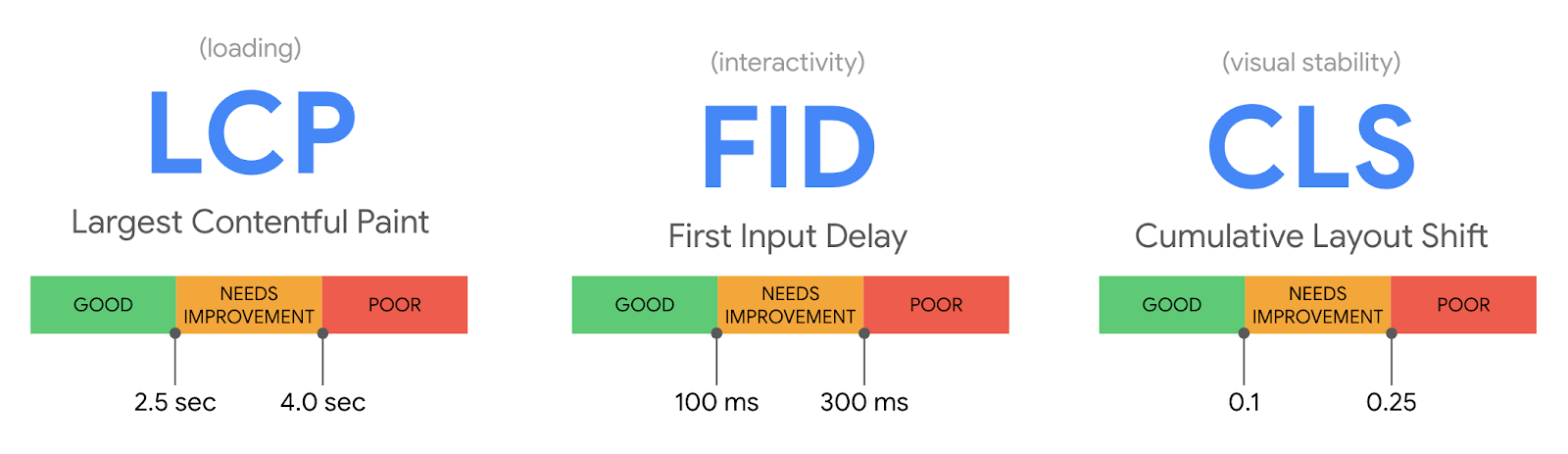
3. Core Web Vitals: Performance as a Ranking Signal
Site speed and stability have moved from being a “nice to have” to being treated as direct signals of quality. For e-commerce specifically — where users are constantly filtering, zooming into images, and adding items to carts — performance issues translate almost immediately into lost revenue.
Three metrics matter most:
Metric | What It Measures | Why It Matters for E-Commerce |
|---|---|---|
Largest Contentful Paint (LCP) | How quickly the main visible content loads | Slow-loading hero images or blocking scripts frustrate users before they even see a product |
Interaction to Next Paint (INP) | How responsive a page stays throughout the entire visit (replacing the older First Input Delay metric) | Captures the ongoing experience — filtering, adding to cart, zooming — not just the first click |
Time to First Byte (TTFB) | How quickly the server starts responding | Slow databases, missing caching, or DNS delays create a sluggish foundation that no front-end optimization can fully mask |
Modern approaches to solving these issues include shifting logic closer to the user through edge computing (running code on distributed edge servers instead of one central server, cutting latency significantly) and adopting next-generation image formats designed for smaller file sizes without visible quality loss, combined with lazy loading so images only load as users scroll to them.
There’s also a fourth, often-overlooked factor: Cumulative Layout Shift (CLS) — the visual “jumping” that happens when elements like banners or recommendation widgets load after the rest of the page. Reserving space for these elements in advance prevents accidental clicks and keeps the checkout experience feeling stable and trustworthy.
4. Structured Data: Teaching Machines to Read Your Catalog
Perhaps the most important shift in e-commerce technical SEO is the growing role of structured data (schema markup). In a search landscape increasingly shaped by AI-generated answers, structured data isn’t just about getting a nicer-looking search result — it’s the actual language machines use to understand what a product is, what it costs, whether it’s in stock, and how it relates to other products.
Key structured data properties for e-commerce include:
- Product name — establishes a clear, definitive identity for the item.
- Offer details — price, currency, and availability, which are essential for anything transactional.
- Aggregate rating — surfaces star ratings and can meaningfully lift click-through rates.
- isVariantOf — links multiple versions of a product (different sizes or colors) back to one parent entity.
- Shipping details — lets search engines and AI assistants answer questions like “does this offer free shipping?” directly.
- Return policy information — allows post-purchase questions to be answered before a customer even lands on the site.
Review schema deserves special mention: it’s what turns customer feedback into visible, eye-catching rich snippets in search results. But it comes with a strict rule — the ratings shown in the underlying code must exactly match what’s visible to users on the page, or the site risks being flagged for misleading structured data. Because of this accuracy requirement, many larger retailers now rely on automated systems that update this markup dynamically as new reviews are approved, rather than editing it by hand.
Why All of This Matters More Than Ever
None of these technical layers work in isolation. A perfectly optimized product description means little if crawlers can’t reach the page, if it loads too slowly to hold a mobile visitor’s attention, or if the underlying data isn’t structured clearly enough for search engines — or increasingly, AI answer engines — to trust and cite it.
As search shifts from simple keyword matching toward AI-driven, conversational discovery, the technical foundation of a site has effectively become the “grammar” that machines use to understand a brand’s inventory. Get it right, and everything built on top of it — content, reviews, off-page authority — has a stable structure to stand on. Get it wrong, and even the best content marketing in the world will struggle to reach its audience.
This piece draws on and synthesizes concepts from the technical infrastructure section of Nitin Patki’s research on e-commerce SEO strategies, published in the International Journal of Emerging Trends in Computer Science and Information Technology (2026).
Frequently Asked Questions
-
What is crawl budget, and why does it matter for e-commerce sites?
Crawl budget is the limited amount of attention a search engine allocates to crawling your site. On large catalogs, poorly managed filter combinations (faceted navigation) can generate thousands of near-duplicate URLs that eat up this budget, leaving important product and category pages crawled less often — or missed entirely.
-
Should all filtered URLs be indexed?
No. High-value, specific combinations (like "men's blue running shoes") are worth indexing as clean static URLs. Low-value combinations, pure sorting options (price, newest), and multi-select filters should generally be blocked or canonicalized back to the parent category to avoid diluting ranking signals.
-
What are Core Web Vitals, and which ones matter most for online stores?
Core Web Vitals are performance metrics search engines use as ranking signals. For e-commerce, the key ones are Largest Contentful Paint (how fast main content loads), Interaction to Next Paint (how responsive the page stays during filtering, cart actions, etc.), and Time to First Byte (server responsiveness). Cumulative Layout Shift also matters for preventing accidental clicks during checkout.
-
Why does mobile-first indexing matter so much for e-commerce SEO?
Since most search engines now evaluate the mobile version of a site to determine rankings, any gap between mobile and desktop — missing content, blocked resources, layout shifts — can directly suppress visibility, even if the desktop site is fully optimized.
-
How does structured data (schema markup) help with SEO today?
Structured data gives search engines and AI systems a machine-readable way to understand product names, prices, availability, variants, shipping, and return policies. Beyond rich snippets, it's increasingly what allows AI assistants to confidently cite and recommend a brand's products in generative search results.