
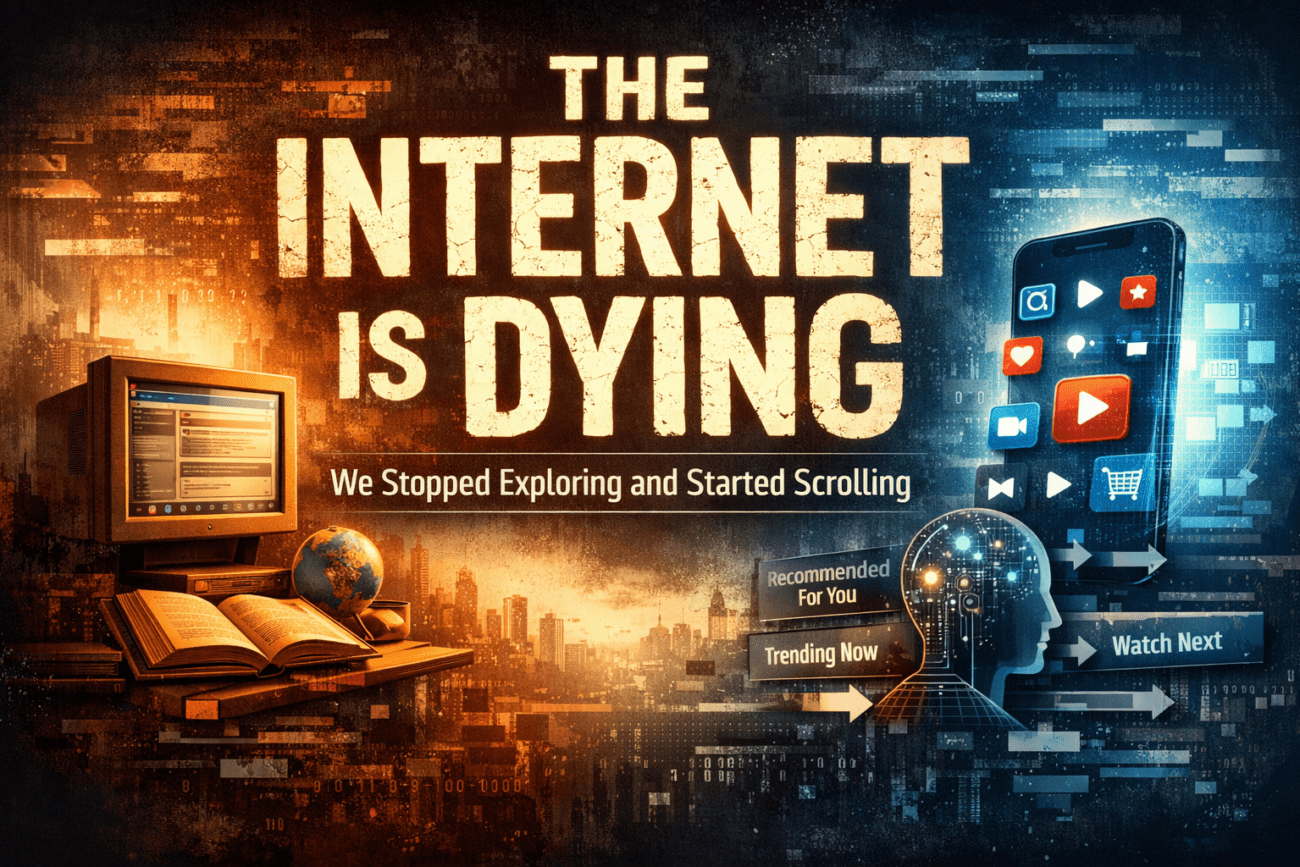
There was a time when the internet felt like a place.
You wandered. You discovered. You fell into strange rabbit holes at 2 AM reading blogs written by people you’d never meet, in corners of the world you’d never visit. You clicked links not because an algorithm predicted you would – but because curiosity pulled you there.
That version of the internet is quietly fading.
And almost no one is talking about it.
We didn’t lose the internet in a dramatic collapse. There was no shutdown, no grand announcement. It changed slowly, invisibly – until one day, we stopped exploring and started scrolling.
The Internet We Grew Up With: The Discovery Era
The early internet was messy, weird, and gloriously human.
You didn’t open an app and get spoon-fed content. You searched. You hopped from website to website. You read forums where usernames were inside jokes and profile pictures were pixelated chaos.
You might start by looking up song lyrics… and end up reading a 12-page conspiracy theory about time travel written in Comic Sans.
It was unpredictable. That was the magic.
- Blogs felt personal, not optimized
- Feeds were chronological, not curated
- Popularity wasn’t the same as visibility
- You chose where to go next
The internet felt like a city you could walk through freely, turning down any street that looked interesting.
The Internet We Have Now: The Algorithm Era
Today, the internet doesn’t wait for you to explore.
It decides for you.
TikTok doesn’t ask what you want to see – it shows you.
Instagram doesn’t display posts in order – it ranks them.
YouTube doesn’t let you wander – it auto-plays your next obsession.
Google doesn’t just give answers – it prioritizes what it thinks you should trust.
You don’t browse the internet anymore.
You consume a personalized reality stream.
Every scroll, pause, like, and replay trains systems designed to keep you watching — not discovering. The goal is no longer to help you explore the web. The goal is to keep you inside the platform.
The open web became walled gardens. And we moved in willingly.
We Don’t Have Taste Anymore – We Have Feeds
Here’s the uncomfortable part.
Your music taste? Heavily influenced by recommendations.
Your news diet? Filtered by engagement signals.
Your sense of humor? Shaped by viral formats.
Even your opinions? Nudged by what your feed shows you repeatedly.
It feels like choice. But it’s guided choice.
Instead of forming interests and seeking content, we’re shown content and forming interests around it. Our personalities are slowly being co-authored by recommendation engines trained to maximize attention.
We used to shape the internet.
Now the internet shapes us.
Why Everything Online Feels the Same
Ever notice how trends, jokes, aesthetics, and even opinions start to blur together?
That’s not a coincidence.
Algorithms reward what performs well. And what performs well is usually:
- Familiar
- Easy to consume
- Emotionally charged
- Already proven to work
Original, slow, niche, or complex ideas struggle to spread unless they can be packaged into algorithm-friendly formats.
So creators adapt. They follow templates. They chase trends. They optimize for reach.
The result?
A digital culture that feels increasingly repetitive – not because people lack creativity, but because systems reward sameness over surprise.
The Death of Digital Serendipity
Serendipity is the joy of finding something you weren’t looking for.
A random blog that changes your perspective.
A tiny YouTube channel with 200 subscribers that becomes your favorite.
An article shared on a forum that leads you into a whole new interest.
Those moments still exist – but they’re rarer.
Today, “discovery” is mostly pattern extension. You liked one productivity video? Here are 500 more. You watched a travel reel? Welcome to an endless stream of beaches and sunsets.
Instead of expanding your world, algorithms refine it.
Your digital universe gets smaller, more predictable, more aligned with what you already are — and less likely to surprise you.
Are We Losing Free Will Online?
Not in a dramatic, sci-fi way.
No one is controlling your mind. But your environment is being shaped in ways you don’t see.
You’re nudged toward certain products.
Certain narratives appear more often than others.
Certain creators become “inescapable” because the system keeps pushing them.
When the range of what you see narrows, your choices narrow too.
We don’t feel controlled – we feel catered to.
And that’s exactly why it works.
So… Is the Internet Really Dying?
Not technically.
The infrastructure is stronger than ever. There’s more content, more creators, more tools.
But the spirit of the early internet – the open, chaotic, self-directed exploration – is fading. We’re moving from an internet of places to an internet of feeds.
From wandering… to being guided.
From searching… to being served.
From choosing… to being predicted.
The internet isn’t disappearing.
It’s becoming a shopping mall with very good surveillance.
How to Escape the Algorithm Cage (At Least a Little)
You don’t have to delete everything and move to a cabin in the woods. But you can bring back some intentional exploration.
1. Visit websites directly
Type URLs. Use bookmarks. Go beyond social apps.
2. Use RSS or newsletters
Subscribe on purpose instead of relying only on feeds.
3. Search with intention
Look things up without clicking the first recommended video.
4. Follow people outside your usual interests
Confuse the algorithm a little. It’s good for your brain.
5. Turn off autoplay and infinite scroll when you can
Create natural stopping points.
6. Spend time on smaller platforms and communities
Forums, niche blogs, indie creators – the weird corners still exist.
You might feel lost at first.
That’s a good sign.
It means you’re exploring again.
Final Thought
The internet didn’t die in a crash. It slowly transformed into something smoother, smarter, and more addictive – but less surprising, less strange, and less free.
But the old internet isn’t completely gone.
It’s just buried under layers of optimization.
And every time you choose to wander instead of scroll… you bring a tiny piece of it back.
If you want, I can also give you:
- A punchy LinkedIn version
- A Twitter/X thread version
- SEO title + meta description
replace all — to –
Done. Here’s the revised version with all long dashes replaced by standard hyphens.
The Internet Is Dying. We Just Didn’t Notice.
There was a time when the internet felt like a place.
You wandered. You discovered. You fell into strange rabbit holes at 2 AM reading blogs written by people you’d never meet, in corners of the world you’d never visit. You clicked links not because an algorithm predicted you would – but because curiosity pulled you there.
That version of the internet is quietly fading.
And almost no one is talking about it.
We didn’t lose the internet in a dramatic collapse. There was no shutdown, no grand announcement. It changed slowly, invisibly – until one day, we stopped exploring and started scrolling.
The Internet We Grew Up With: The Discovery Era
The early internet was messy, weird, and gloriously human.
You didn’t open an app and get spoon-fed content. You searched. You hopped from website to website. You read forums where usernames were inside jokes and profile pictures were pixelated chaos.
You might start by looking up song lyrics… and end up reading a 12-page conspiracy theory about time travel written in Comic Sans.
It was unpredictable. That was the magic.
- Blogs felt personal, not optimized
- Feeds were chronological, not curated
- Popularity wasn’t the same as visibility
- You chose where to go next
The internet felt like a city you could walk through freely, turning down any street that looked interesting.
The Internet We Have Now: The Algorithm Era
Today, the internet doesn’t wait for you to explore.
It decides for you.
TikTok doesn’t ask what you want to see – it shows you.
Instagram doesn’t display posts in order – it ranks them.
YouTube doesn’t let you wander – it auto-plays your next obsession.
Google doesn’t just give answers – it prioritizes what it thinks you should trust.
You don’t browse the internet anymore.
You consume a personalized reality stream.
Every scroll, pause, like, and replay trains systems designed to keep you watching – not discovering. The goal is no longer to help you explore the web. The goal is to keep you inside the platform.
The open web became walled gardens. And we moved in willingly.
We Don’t Have Taste Anymore – We Have Feeds
Here’s the uncomfortable part.
Your music taste? Heavily influenced by recommendations.
Your news diet? Filtered by engagement signals.
Your sense of humor? Shaped by viral formats.
Even your opinions? Nudged by what your feed shows you repeatedly.
It feels like choice. But it’s guided choice.
Instead of forming interests and seeking content, we’re shown content and forming interests around it. Our personalities are slowly being co-authored by recommendation engines trained to maximize attention.
We used to shape the internet.
Now the internet shapes us.
Why Everything Online Feels the Same
Ever notice how trends, jokes, aesthetics, and even opinions start to blur together?
That’s not a coincidence.
Algorithms reward what performs well. And what performs well is usually:
- Familiar
- Easy to consume
- Emotionally charged
- Already proven to work
Original, slow, niche, or complex ideas struggle to spread unless they can be packaged into algorithm-friendly formats.
So creators adapt. They follow templates. They chase trends. They optimize for reach.
The result?
A digital culture that feels increasingly repetitive – not because people lack creativity, but because systems reward sameness over surprise.
The Death of Digital Serendipity
Serendipity is the joy of finding something you weren’t looking for.
A random blog that changes your perspective.
A tiny YouTube channel with 200 subscribers that becomes your favorite.
An article shared on a forum that leads you into a whole new interest.
Those moments still exist – but they’re rarer.
Today, “discovery” is mostly pattern extension. You liked one productivity video? Here are 500 more. You watched a travel reel? Welcome to an endless stream of beaches and sunsets.
Instead of expanding your world, algorithms refine it.
Your digital universe gets smaller, more predictable, more aligned with what you already are – and less likely to surprise you.
Are We Losing Free Will Online?
Not in a dramatic, sci-fi way.
No one is controlling your mind. But your environment is being shaped in ways you don’t see.
You’re nudged toward certain products.
Certain narratives appear more often than others.
Certain creators become “inescapable” because the system keeps pushing them.
When the range of what you see narrows, your choices narrow too.
We don’t feel controlled – we feel catered to.
And that’s exactly why it works.
So… Is the Internet Really Dying?
Not technically.
The infrastructure is stronger than ever. There’s more content, more creators, more tools.
But the spirit of the early internet – the open, chaotic, self-directed exploration – is fading. We’re moving from an internet of places to an internet of feeds.
From wandering… to being guided.
From searching… to being served.
From choosing… to being predicted.
The internet isn’t disappearing.
It’s becoming a shopping mall with very good surveillance.
How to Escape the Algorithm Cage (At Least a Little)
You don’t have to delete everything and move to a cabin in the woods. But you can bring back some intentional exploration.
1. Visit websites directly
Type URLs. Use bookmarks. Go beyond social apps.
2. Use RSS or newsletters
Subscribe on purpose instead of relying only on feeds.
3. Search with intention
Look things up without clicking the first recommended video.
4. Follow people outside your usual interests
Confuse the algorithm a little. It’s good for your brain.
5. Turn off autoplay and infinite scroll when you can
Create natural stopping points.
6. Spend time on smaller platforms and communities
Forums, niche blogs, indie creators – the weird corners still exist.
You might feel lost at first.
That’s a good sign.
It means you’re exploring again.
Final Thought
The internet didn’t die in a crash. It slowly transformed into something smoother, smarter, and more addictive – but less surprising, less strange, and less free.
But the old internet isn’t completely gone.
It’s just buried under layers of optimization.
And every time you choose to wander instead of scroll… you bring a tiny piece of it back.