TL;DR – Liz Reid told Bloomberg that AI Overviews are removing “bounce clicks,” not visits from users seeking deeper information. Google has made the same basic case for a year, but still has not published data to back it up. Independent studies show lower CTRs and referral traffic overall.
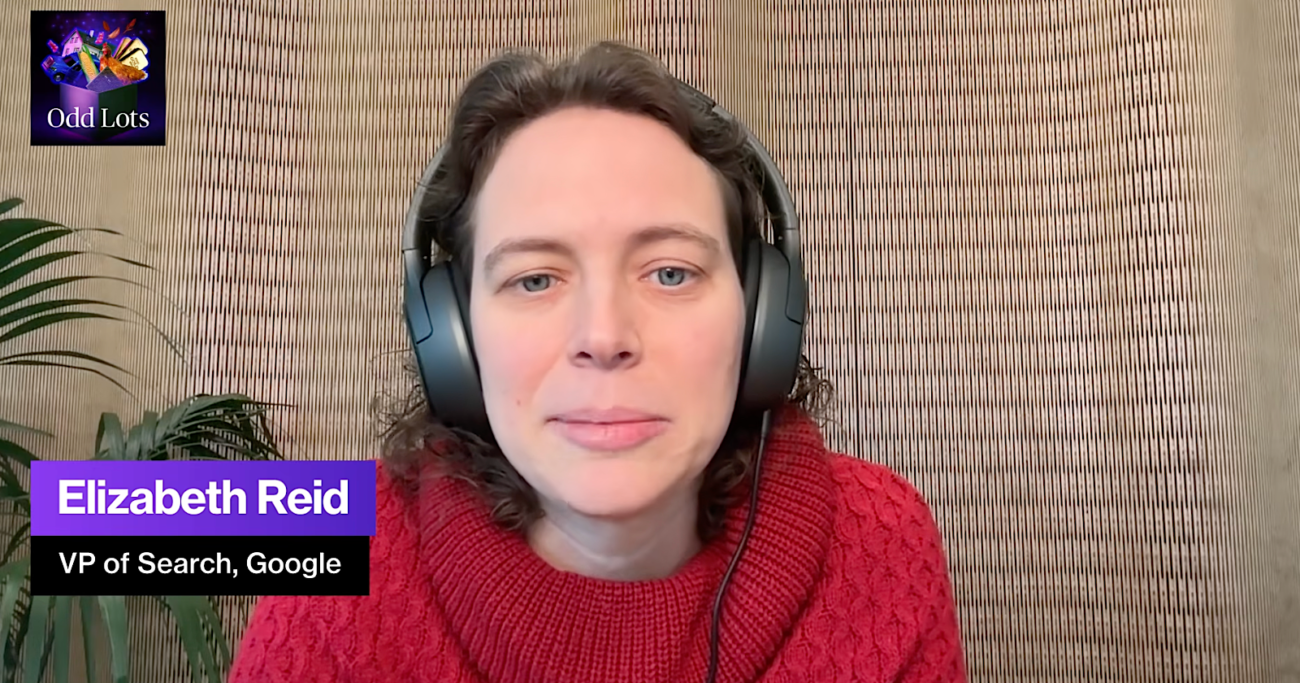
Google’s head of Search, Liz Reid, told Bloomberg’s Odd Lots podcast that AI Overviews are reducing “bounce clicks” from publisher pages, continuing an argument she has made in public appearances since last year.
Reid appeared on the April 23 episode of Odd Lots. Hosts Joe Weisenthal and Tracy Alloway asked how AI Overviews affect publisher traffic and ad revenue.
Here’s the summary from the podcast:
Google’s Explanation: “Bounce Clicks”
Google claims that AI Overviews aren’t actually “stealing” traffic—they’re just eliminating low-value clicks called “bounce clicks.”
What Google says or argues about AI Oversviews
- Google’s Head of Search, Liz Reid, argues AI Overviews reduce clicks where users:
- Click a result
- Immediately return to search (because they got a quick answer)
- These are labeled “bounce clicks”—and Google says they weren’t valuable anyway.
- According to Google:
- Users who want deeper info still click through
- Overall search activity (queries) may increase, offsetting lost clicks
The Counterargument: Traffic Is Still Dropping
- Google has not provided data to support its claims
- Independent studies show:
- Lower click-through rates (CTR) when AI Overviews appear
- Organic traffic drops (often significant)
- The concern:
AI answers may replace visits entirely, not just low-quality clicks
The real debate
- Google’s framing:
AI improves efficiency by removing unnecessary clicks - Publishers’ view:
AI Overviews are reducing real traffic and revenue, not just “junk” clicks
The Bigger Picture of AI overviews
Google is defending AI Overviews by saying they filter out low-value visits—but external evidence suggests they may be reducing meaningful traffic, and Google hasn’t shared data to prove otherwise.
At its core, the debate comes down to this:
- Google’s view: AI makes search more efficient by cutting unnecessary steps
- Publishers’ view: AI is becoming a gatekeeper that keeps users on Google
Related FAQs
-
What is a “bounce click” according to Google?
A bounce click is when a user clicks a search result and quickly returns to the search page without engaging further. Google considers these low-value interactions.
-
Are AI Overviews reducing website traffic?
Evidence suggests they can reduce click-through rates and organic traffic, especially for informational queries. However, Google claims the impact is limited to low-value clicks.
-
Why hasn’t Google shared data to support its claims?
Google has not released detailed public data on AI Overview performance, which is a major point of criticism among SEO experts and publishers.
-
Which types of content are most affected?
Content that answers simple questions—like definitions, quick guides, or factual queries—is most at risk, since AI can summarize it directly.
-
Should website owners be worried?
It depends on your content strategy. Sites relying heavily on quick-answer traffic may see declines, while those offering deeper insights or unique value may remain more resilient.
-
How can publishers adapt?
- Focus on in-depth, original content
- Build brand authority and direct audiences
- Optimize for queries that require human insight or expertise