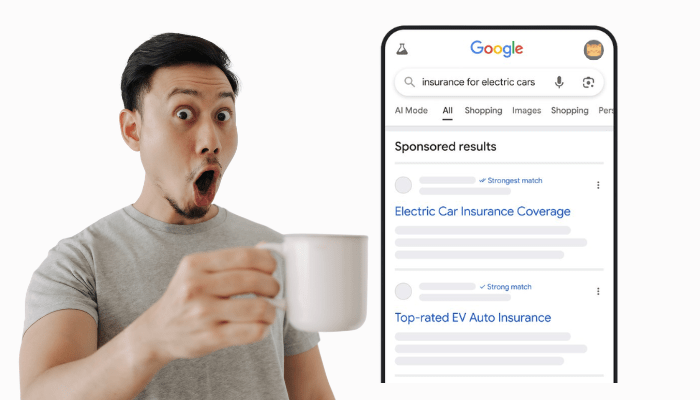
Google is experimenting with a new Search Ads feature that could give advertisers deeper insight into how its advertising system evaluates relevance between user queries and ad creatives.
The company has been spotted testing labels such as “Strongest Match” and “Strong Match” directly within Search Ads, potentially signaling how closely a displayed ad aligns with a user’s search intent. The test was first noticed by industry observers and has already sparked discussion among PPC professionals about whether Google is preparing to offer more transparency around ad-serving decisions.
While Google has not publicly explained the mechanics behind the labels, the experiment arrives at a time when advertisers are increasingly navigating automated campaign types, AI-powered bidding systems, and broader keyword matching technologies.
What Are the New ‘Strongest Match’ Labels?
According to screenshots shared by search marketing professionals, Google is testing two visible indicators:
- “Strongest Match”
- “Strong Match”
These labels appear alongside sponsored search listings and seem to communicate the degree of relevance between the ad and the search query entered by the user.
Although advertisers have long relied on metrics such as Quality Score, Ad Rank, expected click-through rate, and keyword relevance to assess performance, these new labels could represent a more user-facing interpretation of Google’s matching systems.
At this stage, Google has not clarified whether the labels are tied to keyword match types, AI-generated relevance assessments, Quality Score calculations, or a separate ranking mechanism altogether.
A Move Toward Greater Transparency?
For years, advertisers have sought more visibility into how Google determines which ads appear for specific searches.
The introduction of “Strongest Match” labels may be an attempt to bridge that information gap. By explicitly indicating relevance levels, Google could help marketers better understand why certain ads receive impressions while others do not.
However, the labels also raise new questions.
Advertisers currently lack information about:
- The exact criteria used to assign the labels.
- Whether relevance is measured against keywords, landing pages, ad copy, or all three.
- How the labels interact with automated bidding strategies.
- Whether advertisers can influence or optimize for these designations.
Until Google provides official documentation, much of the industry’s interpretation remains speculative.
The Broader Context: Google’s Automation Push
The timing of the experiment is notable.
Over the past several years, Google Ads has steadily expanded the role of automation across campaign management. Features such as Smart Bidding, broad match enhancements, AI Max campaigns, and automated asset generation have reduced the need for manual optimization while increasing Google’s reliance on machine learning systems.
Google has repeatedly argued that modern search behavior is more nuanced than exact keyword matching, requiring AI systems to interpret intent rather than simply match text strings. This philosophy has led to broader targeting capabilities and more sophisticated ad delivery systems.
The new labels could be another step in that evolution, providing a visible explanation of how Google’s AI views relevance between a search query and an ad.
Potential Impact on Advertisers
If rolled out more broadly, the labels could influence how advertisers evaluate campaign performance and optimization strategies.
A “Strongest Match” designation may become an indicator that Google’s systems view a particular ad as highly relevant to a searcher’s intent. Conversely, lower-tier labels could signal opportunities for improving ad copy, keyword targeting, or landing page alignment.
The feature could also affect user perception.
Searchers may interpret a “Strongest Match” label as an endorsement of quality or relevance, potentially influencing click behavior. Similar tests involving ad presentation and trust indicators have historically impacted how users engage with paid search results.
For advertisers, that means relevance signals may become increasingly important not only for ad delivery but also for user confidence.
Industry Reaction Remains Mixed
The PPC community has generally welcomed efforts that improve transparency, but marketers remain cautious about drawing conclusions from limited testing.
Many professionals argue that without detailed guidance, the labels risk creating confusion rather than clarity. Others view the experiment as a positive sign that Google recognizes advertiser concerns around automated decision-making and black-box AI systems.
The discussion mirrors broader debates around Google’s growing use of automation, where advertisers often receive improved performance but less visibility into the mechanisms driving results.
What Happens Next?
As with many Google Search experiments, there is no guarantee that the “Strongest Match” labels will see a full public rollout.
Google frequently tests interface changes, ranking indicators, and advertising features with a limited group of users before deciding whether to expand, modify, or discontinue them.
For now, advertisers should monitor industry discussions and Google’s official announcements for additional details regarding how these labels work and whether they will become a standard component of Search Ads.
If the feature survives testing, it could mark one of the most visible attempts by Google to explain ad relevance directly within the search experience—an area that has traditionally remained largely opaque to both advertisers and users.
Conclusion
Google’s test of “Strongest Match” and “Strong Match” labels suggests the company is exploring new ways to communicate ad relevance within Search. While the labels currently raise more questions than answers, they align with Google’s ongoing shift toward AI-driven advertising and intent-based matching.
For marketers, the development is worth watching closely. If adopted widely, these indicators could become a new signal for understanding how Google’s systems evaluate and prioritize ads in an increasingly automated search ecosystem.